TLDR
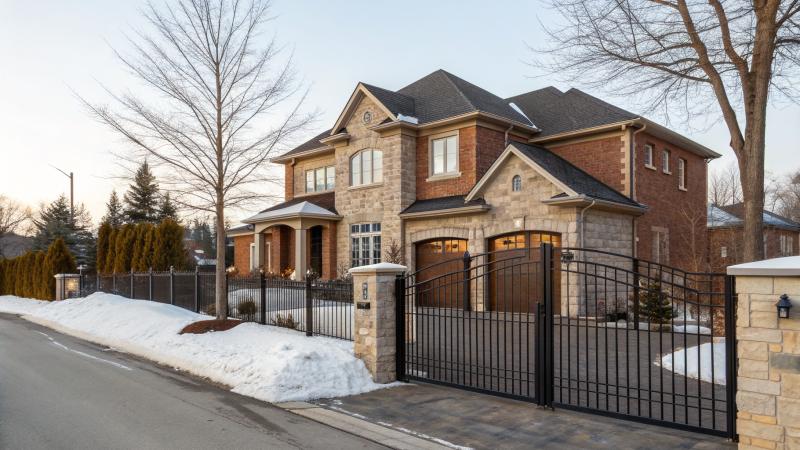
Aluminum gates in the Greater Toronto Area rarely fail because the aluminum wears out. They fail because the post footing lifts with frost, the leaf racks out of square, and the hardware corrodes under road salt. Getting footing depth, frame construction, and hinge hardware right at quote stage prevents nearly every winter gate problem Vaughan and Toronto homeowners call about.
Key Takeaways
- -Most sagging aluminum gates are a post problem, not a gate problem: a footing above the frost line lifts and settles every season and the leaf follows it.
- -A gate leaf holds its square through welded corners and a diagonal brace, not through how many pickets it has.
- -Hinges carry the full weight of the leaf plus wind load, so bearing supported hinges and stainless fasteners are worth specifying by name.
- -Set 75 to 100 millimetres of ground clearance or packed snow will jam the gate every January regardless of build quality.
- -Road salt attacks on-site cut ends and drilled holes long before it affects the coated faces of the aluminum.
- -Ask for footing depth, corner detail, hinge type, ground clearance, and coating spec in writing before signing a gate quote.

Joseph Cariati
Founder & Owner of HMJ Railings. With over 10 years of experience and 2,000+ completed projects, Joseph and the HMJ team have built lasting relationships with homeowners and builders across Vaughan and the GTA, earning a reputation for reliability and quality work.
A gate that worked perfectly in October stops closing in January. The latch no longer lines up, the bottom rail scrapes the driveway, and by March it seems to correct itself. Most homeowners assume the gate was badly made.
It usually was not. The aluminum is almost never the part that failed.
What Actually Fails on an Aluminum Gate
An aluminum gate is not a single object. It is a leaf, two posts, two footings, and the hardware that connects them. Each of those parts fails differently, and only one of them is made of aluminum.
The aluminum itself is close to permanent. It does not rust. Exposed aluminum forms a thin oxide layer that slows further corrosion instead of feeding it, which is why a scratched picket does not spread the way a scratched steel one does.
Gate problems in this climate show up as three symptoms. The leaf drops on the latch side, which people call sag. The leaf binds against the ground or the post, which people call sticking. Or the hardware seizes, wears oval, and eventually snaps.
Every one of those symptoms traces back to a decision made before the gate was ever hung.
Failure 1: Footings That Stop Above the Frost Line
The most common cause of a sagging gate in the Greater Toronto Area is a hinge post footing that does not reach below the frost line.
Water in the soil around a shallow footing freezes and expands. The expanding soil grips the sides of the concrete and lifts it, and the post rises with it. A lift of ten millimetres at the footing becomes a much larger drop at the far end of a three metre leaf, because the post is now out of plumb.
The seasonal pattern is what makes this hard to diagnose. The gate goes out of alignment in December, gets worse through February, and partially settles back in April. Homeowners see it improve and conclude the problem solved itself. It did not. The post is cycling, and each cycle loosens the soil around it further.
A correctly specified footing extends below the local frost depth, which is commonly taken as about 1.2 metres in southern Ontario. The post is set in poured concrete rather than tamped gravel, and the base of the footing is wider than the shaft so the frozen soil has less to grab and lift.
Failure 2: A Leaf That Was Never Braced to Stay Square
A gate leaf is a rectangle asked to hold its shape while hanging from one edge. Without something resisting the diagonal, gravity slowly pulls that rectangle into a parallelogram.
Mechanically fastened corners are where this starts. Screws and corner keys hold well when new, but every open and close cycle works them slightly. Over a few thousand cycles the joint develops play, the leaf loses square, and the latch stile drops.
Welded corners that are coated after welding do not develop that play. On leaves wider than roughly two metres, an internal diagonal or a tension cable adds the resistance the frame alone cannot supply.
Scale is what makes this visible. A 900 millimetre walk gate can survive weak corners for years because there is so little leverage on the joints. A three metre driveway leaf will show the same weakness within a single season.
Failure 3: Hinges Sized for the Catalogue, Not the Leaf
The hinge carries the full weight of the leaf plus every wind load that hits it. On a solid privacy leaf, that wind load can exceed the weight of the gate itself.
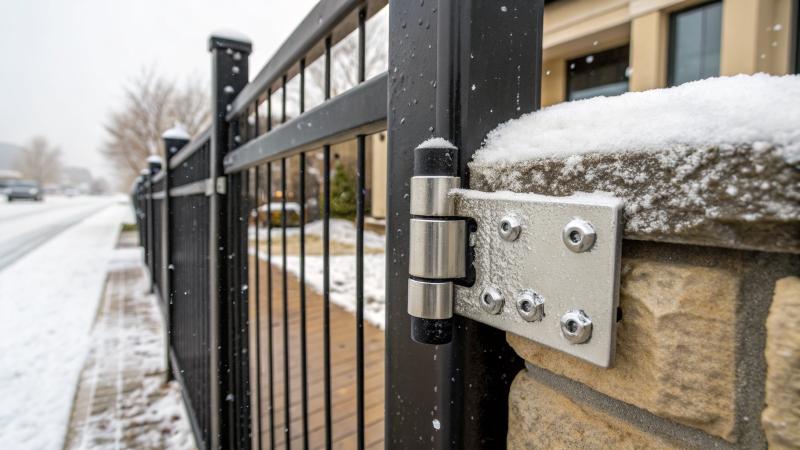
Inexpensive hinges use a plain pin turning inside a plain barrel. Under constant load that pin wears oval, and an oval pin means the leaf drops a few millimetres and then keeps dropping. Ball bearing or bushed hinges spread the same load across a bearing surface and hold their position for years.
Fastener choice matters as much as hinge choice. Plain steel bolts in an aluminum frame create a galvanic pair, and salt spray turns that pair into a battery. The result is a chalky white deposit at the joint and a fastener that will not come out when the gate needs service. Stainless fasteners with isolating washers avoid it.
Tall or heavy leaves need three hinges rather than two, and adjustable hinges are worth specifying because they let an installer correct minor movement without rebuilding anything.
Joseph Cariati, Founder and Owner of HMJ Railings, has completed more than 2,000 projects across Vaughan and the Greater Toronto Area over more than 10 years. Gate failures in this climate are not varied. They repeat in the same order: footing first, frame second, hardware third.
Failure 4: No Clearance for Snow, Ice, and Grade
A gate installed in July with a 25 millimetre ground clearance will not open in January. Packed snow and refrozen meltwater build a ridge along the swing path that is easily 75 millimetres thick by mid winter.
Specify 75 to 100 millimetres of clearance under the leaf and accept that it looks like a larger gap in summer. If the appearance matters, a drop rod or an adjustable stop closes the visual gap without closing the physical one.
Grade decides whether a swing gate is the right choice at all. If the driveway rises toward the house, an inswing leaf binds on the slope before it is fully open. Outswing onto a municipal sidewalk is usually not permitted, which leaves a cantilever slide gate or a bi-fold as the workable options.
Automated gates raise the stakes. A leaf that binds forces the operator, and the operator either strips its drive or trips the obstruction sensor repeatedly. Homeowners who get tired of the sensor tripping often disable it, which removes the one feature that stops the gate closing on a child or a car.
Failure 5: Coating and Cut Edges Exposed to Road Salt
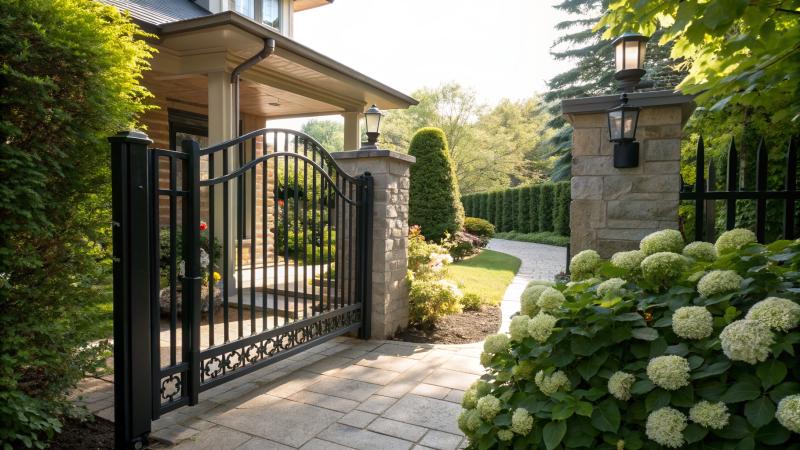
Powder coating is the barrier that keeps salt off the aluminum, and it fails at edges long before it fails on faces.
Factory coated components are sealed on every surface. The moment a picket is cut to length on site or a hole is drilled for a latch, raw aluminum is exposed at that edge. Brine spray from a salted road finds those edges first, corrosion starts under the coating lip, and the coating begins to lift.
This is why the visible damage on a five year old gate is almost always concentrated at cut ends, drilled holes, and the bottom rail nearest the driveway apron.
Ask for components cut and coated at the shop rather than trimmed on site, cut ends capped or sealed, and an architectural grade coating rather than a general purpose one. Then rinse the gate with a garden hose once in early spring. High pressure washing does the opposite of what people expect, because it drives water under any coating edge that has already lifted.
What Vaughan and GTA Conditions Change About Gate Specs
Three local conditions change how a gate should be specified in Vaughan, Toronto, and the surrounding municipalities.
Winter road maintenance across York Region and the City of Toronto puts salt brine into the air near every street facing gate. Gates set close to the road apron take far more chloride exposure than a backyard pool gate does, and the coating and fastener specification has to match that exposure.
Snow clearing is the second condition. Plow operators and driveway contractors push snow toward property edges, and the corner post nearest the apron absorbs that load repeatedly through the season. That post deserves a deeper and wider footing than the one on the quiet side of the driveway.
Municipal pool enclosure by-laws are the third. Gates providing access to a pool must be self closing and self latching, which means a spring is loading the hinge every hour of every day rather than only when someone walks through. Hardware that would last a decade on a garden gate will not last that long under constant spring tension.
What to Ask Before You Sign a Gate Quote
Ask how deep the footings go, and get the number in metres rather than a reassurance that they are deep enough.
Ask whether the frame corners are welded and then coated, or mechanically fastened after coating.
Ask what hinge is being used, whether it is bearing supported, whether it is adjustable, and how many are going on each leaf.
Ask what ground clearance the gate is being set at, and how that number was chosen.
Ask which components are cut and coated in the shop, and which are cut on site.
A supplier who answers those five questions in writing is quoting a gate designed for this climate. A supplier who cannot is quoting a gate that will look identical in July and behave very differently in January.
One Thing to Check This Week
Walk out to your gate and close it. If the latch does not meet cleanly, stand back and look at the hinge post rather than the gate.
A post leaning even slightly off plumb tells you the footing is moving, and that is worth addressing before another freeze and thaw cycle makes it worse. Almost everything else on a gate can be adjusted. A footing poured too shallow has to be redone.
Frequently Asked Questions
Why does my aluminum gate sag on one side?
A sagging aluminum gate almost always means the hinge post has moved or the leaf has racked out of square. Frost lifting a shallow footing is the most common cause in Ontario, followed by worn hinge pins on a heavy leaf.
How deep should a gate post footing be in the GTA?
Gate post footings in the Greater Toronto Area should extend below the frost line, commonly taken as about 1.2 metres in southern Ontario. Anything shallower will lift and settle each season and pull the gate out of alignment.
Do aluminum gates rust in winter?
Aluminum does not rust. It can corrode where the powder coating is broken, particularly at on-site cut ends and drilled holes exposed to road salt. Steel fasteners used in an aluminum frame are usually the first parts to show corrosion.
Should I choose a swing gate or a sliding gate for my driveway?
Choose a sliding gate when the driveway slopes toward the house, the opening is wide, or snow storage blocks the swing path. Swing gates suit level driveways with room to open inward and usually cost less to install.
How much clearance should a gate have above the ground?
Leave 75 to 100 millimetres between the bottom of the leaf and the ground so packed snow and ice do not jam the gate. Use a drop rod or adjustable stop if the larger gap looks wrong in summer.
When is the best time of year to install a driveway gate in Ontario?
Late spring through early fall is best, because footings need workable ground and concrete needs to cure above freezing. Booking in winter for a spring installation usually secures better scheduling than waiting until the busy summer season.
About the Author

Joseph Cariati
Founder & Owner of HMJ Railings. With over 10 years of experience and 2,000+ completed projects, Joseph and the HMJ team have built lasting relationships with homeowners and builders across Vaughan and the GTA, earning a reputation for reliability and quality work.