TLDR
Ontario's Building Code requires guard rails on any drop greater than 600mm, with minimum heights of 36 inches (or 42 inches if the walking surface sits more than 1,800mm above grade) and picket openings small enough to block a 4-inch sphere. Pool enclosures across the GTA need a 1.2-metre minimum and a self-closing, self-latching gate. Most Vaughan and Toronto deck railing projects also require a permit before work begins.
Key Takeaways
- -Residential guards must be at least 36 inches (915mm) tall — 42 inches (1,070mm) when the walking surface is more than 1,800mm above grade
- -Picket and infill openings cannot allow a 4-inch (100mm) sphere to pass through, regardless of style
- -Stair guards measure from the nosing and have their own minimum height of 36 inches
- -Pool enclosures across the GTA must be at least 1.2 metres tall with self-closing, self-latching gates
- -Glass railings must use tempered or laminated safety glass and may require structural certification
- -Vaughan, Toronto, and most GTA municipalities require a permit before installing or replacing exterior guards on raised decks
- -Working with a licensed installer who handles permits, drawings, and inspection sign-off saves rework and delays

Joseph Cariati
Founder & Owner of HMJ Railings. With over 10 years of experience and 2,000+ completed projects, Joseph and the HMJ team have built lasting relationships with homeowners and builders across Vaughan and the GTA, earning a reputation for reliability and quality work.
A railing isn't just trim — it's a life-safety device that has to meet the Ontario Building Code (OBC) before a city inspector will sign off your deck, balcony, porch, or pool enclosure. Heights are measured down to the millimetre, picket openings are tested with a literal sphere, and a missed detail can mean a failed inspection or a forced rebuild. This guide breaks down the railing rules that matter most for Vaughan and Greater Toronto homeowners in 2026, so you can plan your project — aluminum, framed glass, or frameless — with confidence.
What the OBC Calls a “Guard” (and Why It Matters)
The Ontario Building Code's term for a railing system is a guard, defined in Section 9.8.8. A guard is the protective barrier required at the open side of any walking surface where the drop is greater than 600mm — roughly 24 inches. That includes decks, balconies, porches, landings, mezzanines, and the open side of stairs. A guard is not the same as a handrail, which is the graspable rail you hold while moving up or down a flight. On a residential deck, the railing system you see — posts, top rail, and infill — is your guard, and the OBC controls how tall it must be, how its members are spaced, and how much load it must hold.
Why does this distinction matter? Because every dimension below — heights, spacings, certifications — is tied to the OBC's definition of a guard. Get the category right, and the rest of the math falls into place.
Required Guard Heights for Decks, Balconies, and Porches
Two height numbers cover most residential projects in Ontario:
36 inches (915mm) — The Standard
For most residential decks, balconies, and porches where the walking surface is 1,800mm or less above the surrounding grade, the minimum guard height is 36 inches measured from the deck or balcony surface to the top of the railing. This is the typical height for a backyard deck a few feet off the ground.
42 inches (1,070mm) — Tall Decks and Higher Balconies
Once the walking surface is more than 1,800mm (about 6 feet) above the grade or surface below, the minimum height jumps to 42 inches. Second-storey balconies, walk-out decks over a basement, and most rooftop terraces fall in this category. If your aluminum or glass railing was specced for a low deck and your project is actually 1,800mm-plus off the ground, the system will fail inspection — even if everything else is correct.
Pool Decks and Hot Tubs
A deck attached to a pool or hot tub may need to satisfy both the guard rule (for any drop) and the pool-enclosure rule (a separate 1.2-metre minimum, covered below). When both apply, the higher requirement governs.
Picket Spacing and the 4-Inch Sphere Test
The OBC controls infill openings to keep small children from slipping through or getting stuck. The rule sounds technical but is easy to remember: no opening within a guard can permit a 100mm (4-inch) sphere to pass through. Inspectors carry an actual sphere on a stick to test it.
This applies to:
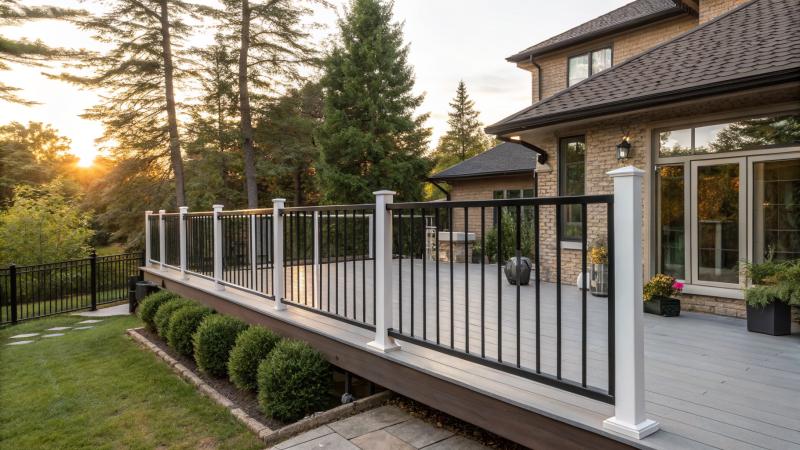
- Vertical aluminum pickets — typical 4-inch on-centre spacing puts you at the limit; 3.5-inch spacing is the safe target
- Horizontal cable or tube infill — the gap between cables must stay under 4 inches at full design tension
- Decorative or geometric panels — the largest opening anywhere in the panel is what gets measured
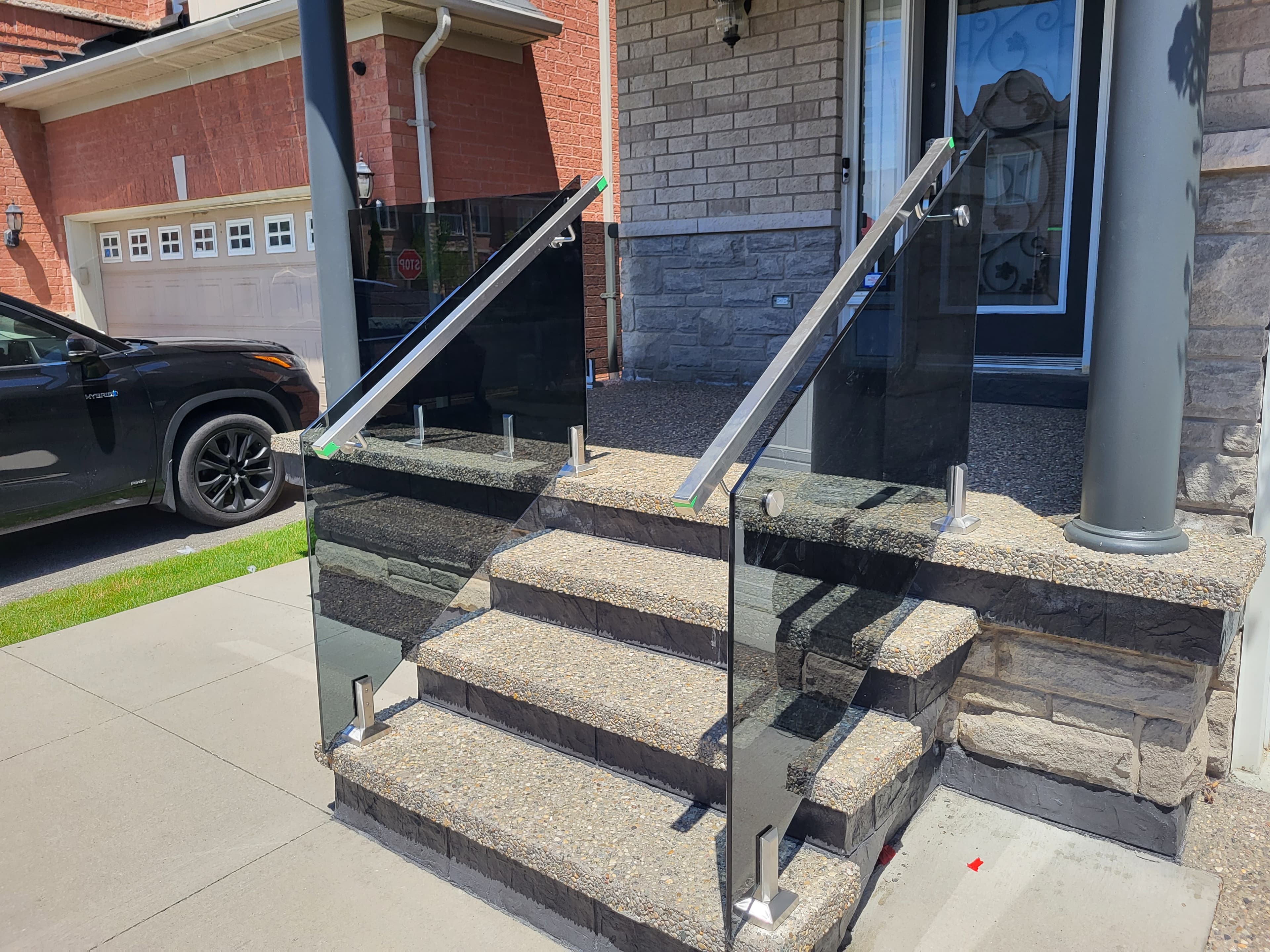
- Glass railings — generally pass automatically because the panels are continuous, but the gap between panels and the gap between the bottom of the panel and the deck both count
For stair guards, the rule loosens slightly: a 4-inch sphere is still the limit through pickets, but the triangular opening formed by the riser, tread, and bottom rail can be up to 150mm (6 inches) — a small allowance unique to stairs.
Stair Guards and Handrails
Stairs add a second component to the railing system: the handrail. The OBC requires a graspable handrail on at least one side of any flight with more than three risers in a private home. The handrail must be 865–965mm (about 34–38 inches) measured vertically from the stair nosing.
The stair guard — the barrier preventing falls off the side of the stair — has its own minimum height of 36 inches measured from the nosing line. On exterior stairs, both the guard and the handrail must be present and continuous. Many GTA homeowners assume their existing aluminum railing serves as both, and on most properly engineered systems it does, but the geometry has to be checked at the corner where the deck meets the stair stringer.
Pool Fencing Rules Across the GTA
Pool enclosures in Ontario are governed by both the OBC and a layer of municipal pool by-laws. The requirements stack — your fence has to satisfy the strictest of the two.
The common baseline across Vaughan, Toronto, Markham, Richmond Hill, and the rest of the GTA:
- Minimum height of 1.2 metres (about 48 inches) measured from grade on the public side
- No openings larger than 100mm anywhere in the enclosure
- Bottom of the fence within 100mm of grade
- Self-closing and self-latching gates with the latch at least 1.5 metres above the ground or on the pool side
- No climbable horizontal members between 100mm and 900mm above the ground
Many GTA municipalities also require pool enclosure inspection separate from the deck or building permit. In Vaughan, for example, a pool enclosure permit is mandatory before water is added. Aluminum picket and framed glass railings both work for pool enclosures provided the picket spacing and gate hardware satisfy the by-law — but check the latest local rules before ordering a system.
Glass and Aluminum Certification Requirements
Material rules are short but unforgiving:
- Glass infill must be either tempered or laminated safety glass. For frameless systems where the glass is the primary structural element, laminated tempered (heat-soaked) glass is increasingly required, and many inspectors ask for the manufacturer's load test certificate showing the system meets the OBC's lateral load requirements (typically 0.75 kN/m on the top rail for residential).
- Aluminum picket systems must be commercial-grade, with welded or mechanically-fastened connections engineered for the same lateral load. Most reputable suppliers stamp their systems for code compliance, and a good installer keeps the data sheets on file for your inspection package.
- Top rails on guards must resist a horizontal point load of 0.5 kN at any point — the equivalent of an adult leaning hard against the rail.
Decorative trim on a powder-coated rail looks great, but it doesn't pass inspection on its own — the underlying engineered system has to be certified.
Permits and Inspections in Vaughan and the GTA
Most exterior railing installations on a deck above 600mm require a building permit in the GTA. Vaughan's Building Standards department, Toronto's Building division, and the equivalents in Markham, Richmond Hill, and Mississauga all follow the same general process: drawings, lot survey if applicable, a permit fee, and a final inspection.
A few common scenarios:
- New deck with new railings — one permit covers both, with framing and final inspections.
- Replacing existing railings on an existing deck — still typically requires a permit if the deck is more than 600mm above grade. Like-for-like replacements sometimes qualify for a streamlined permit, but never assume.
- New pool enclosure — a separate pool fencing permit is the norm and, in Vaughan, must be in place before water is added.
- Balcony or rooftop guard replacement on a condo or townhouse — the corporation's structural engineer is usually involved, and the building's by-laws may govern style and finish on top of the OBC.
Pulling the permit yourself is allowed, but most homeowners delegate it to their installer to keep drawings, dimensions, and inspection coordination in one hand.
A GTA Homeowner's Code-Compliant Railing Checklist
Before you commit to a railing project — aluminum, framed glass, or frameless — work through this list:
- Measure the walking surface height above the surrounding grade: under 1,800mm = 36 inches minimum, over 1,800mm = 42 inches minimum
- Confirm picket or infill openings stay under 100mm
- Verify stair guards measure 36 inches from the nosing and that a graspable handrail is present
- For pool decks, layer the 1.2m enclosure rule and self-closing gate hardware on top
- Ask your supplier for the engineered data sheet on the railing system you're buying
- Confirm a building permit is open before installation begins, and budget for the inspection fee
- Schedule the final inspection promptly — open permits can hold up future renovations or a home sale
After 2,000-plus railing projects across the GTA, the failure I see most often isn't a wrong height — it's the picket spacing being just slightly off because someone trusted the showroom number instead of measuring on the deck. Three and a half inches on centre passes every time. Four inches is a coin flip with the inspector's sphere. The safer measurement saves the rebuild. — Joseph Cariati, Founder & Owner, HMJ Railings
Building a Code-Compliant Railing in Vaughan and the GTA
Ontario's Building Code is strict, but the rules are predictable once you know which numbers apply to your project. The hard part for most homeowners is matching the right system — aluminum picket, framed glass, or frameless — to the height, span, and inspection requirements of their specific deck or pool. HMJ Railings has been pulling permits, supplying engineered systems, and passing GTA inspections for over a decade. If you're planning a railing project in Vaughan, Toronto, or anywhere in the Greater Toronto Area, get a code review built into your quote before any deposit changes hands.
Related Services
Need code-compliant railings installed by experts? We install aluminum railings, framed glass railings, frameless glass railings, and custom gates and columns across the GTA. Request a free estimate to discuss your project.
Frequently Asked Questions
What is the minimum railing height for a residential deck in Ontario?
For decks where the walking surface is 1,800mm or less above grade, the Ontario Building Code requires a minimum guard height of 36 inches (915mm). When the walking surface sits more than 1,800mm above the surrounding grade, the minimum jumps to 42 inches (1,070mm).
How wide can the gaps be between aluminum railing pickets?
Ontario's Building Code prohibits any opening within a residential guard from allowing a 100mm (4-inch) sphere to pass through. In practice, that means picket spacing of about three and a half inches on centre — a touch tighter than the maximum — passes inspection consistently.
Do I need a building permit to install a railing in Vaughan?
In most cases, yes. Vaughan and most GTA municipalities require a building permit when installing or replacing guards on a deck more than 600mm above grade. Pool enclosures typically need a separate permit before water is added. Your installer can usually pull the permit on your behalf.
What height does pool fencing have to be in the GTA?
GTA municipalities — including Vaughan, Toronto, Markham, and Richmond Hill — require pool enclosures of at least 1.2 metres measured from the public side, with self-closing and self-latching gates. Openings must stay under 100mm and the bottom of the fence must sit within 100mm of grade.
Are frameless glass railings code-compliant in Ontario?
Yes, when built with tempered or laminated safety glass and engineered to the OBC's lateral load requirements. Inspectors typically request the manufacturer's load-test certificate. The gap between glass panels and between the panel base and the deck must also satisfy the 100mm opening rule.
How tall do stair guards have to be?
Stair guards must be at least 36 inches (915mm) measured vertically from the stair nosing line. A graspable handrail is also required on at least one side of any flight with more than three risers, mounted between 865mm and 965mm above the nosing.
About the Author

Joseph Cariati
Founder & Owner of HMJ Railings. With over 10 years of experience and 2,000+ completed projects, Joseph and the HMJ team have built lasting relationships with homeowners and builders across Vaughan and the GTA, earning a reputation for reliability and quality work.